Author: Kirsten Tran
School: Pennsylvania College of Optometry at Salus University
Email: kt***@*****sa.org
Graduating Year:2027
Category: Clinical Optometry, Advocacy
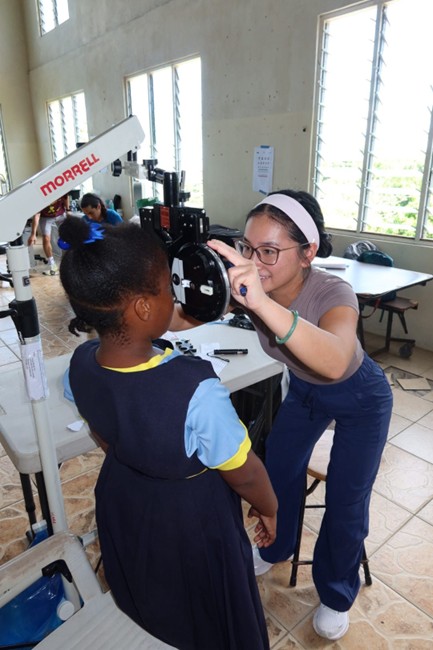
As someone who has always lived – and plans to practice optometry – in the United States, I rarely stop to consider what the field of optometry looks like in other countries. It wasn’t until my most recent trip to Negril, Jamaica, with the Pennsylvania College of Optometry (PCO) chapter of the Student Optometric Service to Humanity (SOSH) that I was made aware of the striking differences in both optometric practice and in access to eye care in general, across the world.
As the PCO SOSH president, Amanda Martinez, OD ’27, shared, “it was humbling to see how even a small improvement [such as a pair of sunglasses] could make such a meaningful difference in someone’s daily life. […] Seeing this level of need reminded me how privileged we are to have access to care at home, and how impactful it can be to help others — even in small ways.” Experiencing firsthand the access and level of eye care available to the people of Negril prompted me to explore how optometry is practiced in other countries.
What I learned was that limited access to eye care isn’t just seen in places such as rural Jamaica; even in many countries and regions considered well-resourced, optometrists’ scopes of practice outside the U.S. can be comparatively restricted. For instance, in Canada, despite recent advocacy efforts, optometrists still cannot independently prescribe all topical and oral drugs, even within the scope of practice. They are also unable to remove foreign bodies that extend beyond the superficial cornea; instead, these patients must be referred to ophthalmologists or to an emergency/hospital setting. Additionally, optometrists in Canada are not yet permitted to independently manage open-angle glaucoma or perform any in-office laser procedures. With the current volume of ophthalmologists, this limited optometric scope may not only delay, but potentially even prevent access to eyecare
Jamaica and Canada are just two examples of the wide variability in the optometric scope of practice worldwide. With all that we currently have in the US, it is easy to forget where we started and how much our profession still differs greatly internationally. It is only through decades of countless advocacy efforts that we’re now able to practice to our fullest scope in most U.S. states. For me, this experience has been an important reminder of the monumental role that advocacy plays in our profession — not only here in the U.S., but globally.